
The science
How bacterial enzymes break down organic sludge
Bacterial enzymes break organic material into smaller molecules that the organisms can use. Strain selection, product format, dose and temperature affect whether that happens where treatment is needed.
01The mechanism
From organic solids to digestion
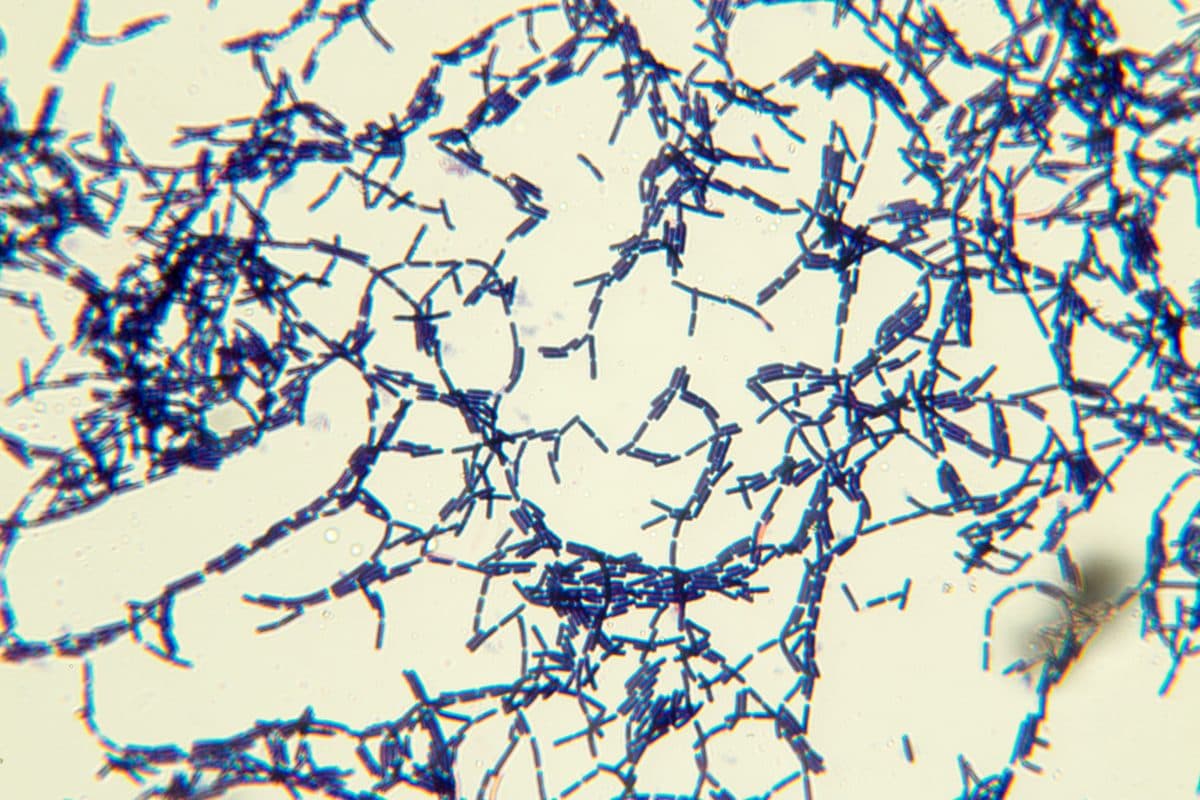
The organism · Bacillus, stained light micrograph. The rod-shaped cells and short chains are the spore-forming genus that secretes the proteases, lipases, amylases and cellulases the four links depend on — and that survives drying, which is why the two lead formats are dry.
Enzymes do the work
Published work shows that mixtures of protease, cellulase and lipase reduce total suspended solids by 30 to 50 per cent and improve settling. Protease plus cellulase outperforms either alone, and lipase augments the effect further.
Bacillus makes the enzymes
The genus Bacillus is the single most important bacterial source of exactly these enzymes, particularly proteases. That is why it is the backbone of essentially every serious product in this category.
Bacillus sporulates
Bacillus forms spores that tolerate drying, making it suitable for dry biological treatment products.
The format must sink
A liquid applied at the surface disperses into the water column. A sinking solid is engineered to fall through it and release at or within the sludge interface, which is where the target actually is.
02Organisms and format
Matching organisms to the treatment task
Different organisms perform different treatment tasks. The table shows why our dry sludge-treatment products do not address nitrogen permits.
| Organism group | What it does to material | Survives drying? | Format implication |
|---|---|---|---|
| Bacillus spore-formers — subtilis, licheniformis, amyloliquefaciens, pumilus, megaterium | Bulk organic digestion. Proteases, lipases, amylases and cellulases acting on volatile solids. | Yes, readily | Free choice of format. These carry the core sludge reduction work. |
| Nitrifiers — Nitrosomonas, Nitrobacter | Ammonia and nitrite oxidation. Directly relevant to nitrogen permit compliance. | No | Liquid only. Roughly twelve-month shelf life, opaque packaging or refrigeration. |
| Pseudomonas and similar Gram-negative heterotrophs | Degradation of more recalcitrant specific organics. | Poorly | Liquid strongly preferred. |
| Photosynthetic and purple non-sulfur bacteria | Metabolic diversity in anaerobic zones; sulfide chemistry. | No | Liquid only. |
03The delivery problem
Getting bacteria to the sludge blanket
In a lagoon six to fifteen feet deep, surface-applied organisms need to reach the bottom sludge and remain there long enough to work. There is limited independent research on how effectively commercial products do this.
The peer-reviewed literature consistently identifies three dominant failure modes for freely suspended introduced cells: washout with effluent, predation by protozoa, and competitive exclusion by the resident community. Standard limnology adds that unmixed water bodies stratify, and that density gradients limit exchange between surface and bottom layers.
You cannot make a liquid sink. A tablet, puck or carrier particle is engineered to fall through the water column and release at or within the sludge interface. When the target is a blanket sitting under six to fifteen feet of water, that is a delivery advantage no reformulation of a liquid can match — which is why at least a dozen independent manufacturers have converged on sinking or carrier-based formats over two decades.
04How to evaluate a supplier
Check the viable-count guarantee
Nearly every cell count published in this category is measured at manufacture. Almost nobody states a guaranteed count at the end of shelf life — which is the number that matters to the operator applying product eighteen months after it was fermented.
Ask for the viable count at manufacture and at the end of shelf life, and request the guarantee in writing.
While you are at it, treat cell count per gram as a weak proxy for performance. What reaches the sludge is concentration multiplied by dose, so a four billion CFU per gram block applied at thirty pounds delivers far more organisms than a ten billion CFU per gram tablet applied at five ounces. Neither figure tells you which species are present, which enzymes they produce, or whether they survive the descent. Use cell count to avoid buying something obviously weak, not to pick a winner.
05Go deeper
Further reading and research
The articles below cover treatment mechanisms, organisms, delivery, operating conditions, field evidence and the claims boundary. Each includes its sources.
Mechanism
How bioaugmentation reduces sludge
Organism
Bacillus in wastewater treatment
Format
Spores, drying and shelf life
Delivery
Getting bacteria to the sludge blanket
Conditions
Temperature, oxygen and pH
Conditions
Mixing, aeration and bioaugmentation
Evidence
What the controlled enzyme studies measured
Evidence
Field evidence, weighed by provenance
Regulatory
Is sludge-reducing bacteria a pesticide?
Prefer the primary sources? The scientific literature page is a cited bibliography of landmark research on bacteria in wastewater and on sludge reduction, from 1914 to now, each entry summarised.
Browse the bibliography