
How bioaugmentation reduces sludge
The biological mechanism by which added microorganisms reduce lagoon sludge — enzymatic hydrolysis of organic solids, cryptic growth, and the volatile-fraction ceiling that limits it — set out against the peer-reviewed sources.
The short answer
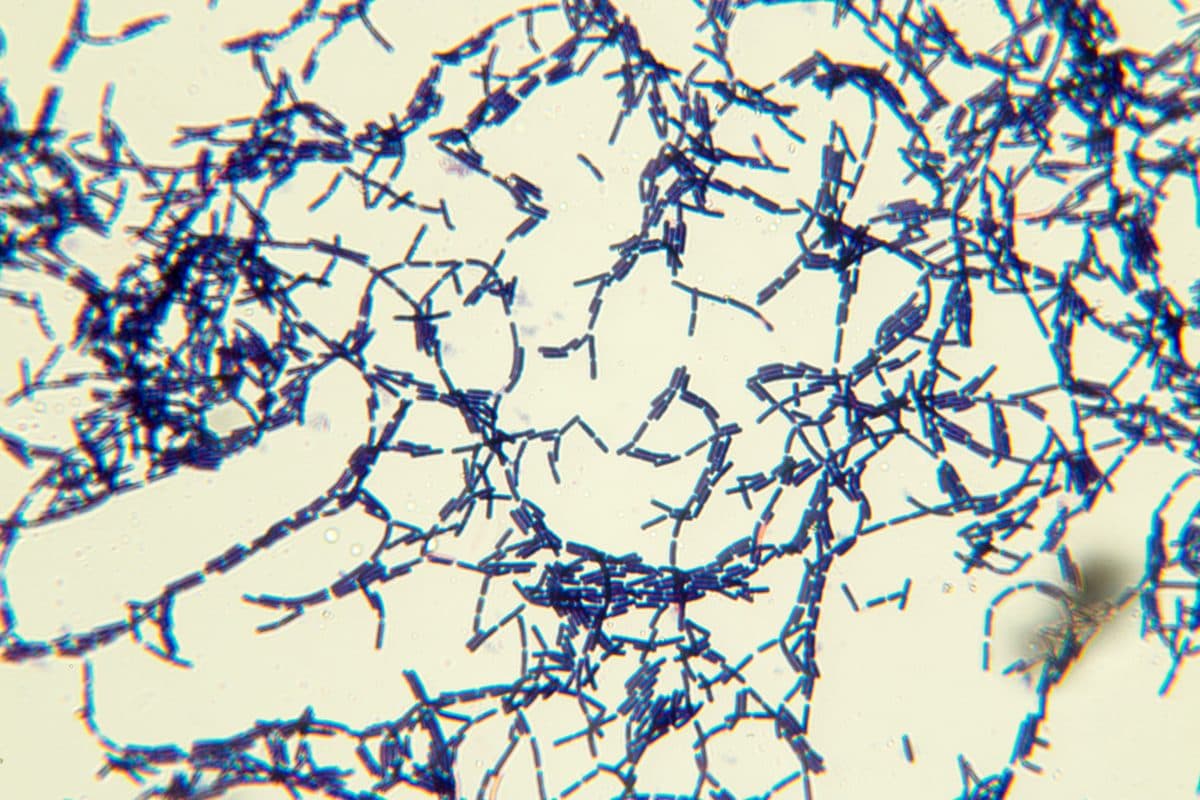
Bioaugmentation uses microbial enzymes to break down organic material. Bacillus and other organisms release proteases, amylases, lipases and cellulases, producing fragments that cells can take up and metabolise. A 2022 bench study reported about 21 per cent total suspended solids and 14 per cent volatile suspended solids removal within 48 hours. These are laboratory results, not predicted lagoon outcomes. Sand, grit, silt, mineral precipitates and plastics remain at any dose.
One mechanism, repeated at scale
Organic sludge contains proteins, fats, starch and cellulose. Bacteria cannot take up these large molecules directly. Enzymes released outside the cells break them into smaller soluble fragments that the bacteria can absorb and metabolise.
Four enzyme classes do almost all of the work, each matched to one component of the material. This is established biochemistry rather than a product claim, and it is the reason format and strain selection matter: a blend is only as useful as the enzymes its organisms actually produce in the conditions of your lagoon.
| Enzyme class | Hydrolyses | In a lagoon blanket that is |
|---|---|---|
| Protease | Proteins and peptides | The protein fraction of settled influent solids and of dead biomass. |
| Amylase | Starches and complex carbohydrates | Carbohydrate load, heaviest on food-processing influent. |
| Lipase | Fats, oils and grease | FOG, which floats and consolidates rather than settling on its own. |
| Cellulase | Cellulose | Plant fibre and paper, a large share of a municipal blanket. |
From hydrolysis to a smaller blanket
Hydrolysis on its own only dissolves solids; it does not remove them. The removal comes from what happens next. The soluble fragments released by the enzymes are taken up by the resident and introduced organisms, oxidised to carbon dioxide and water for energy, and partly converted into new cells. Some of those cells die and lyse in turn, releasing material that is hydrolysed and metabolised again. Across repeated cycles the organic solids are progressively mineralised rather than merely rearranged, and the net effect is a smaller organic mass. In the strain-isolation study cited here the authors attribute the reduction specifically to hydrolysis by proteinase and amylase followed by this cryptic growth, and note that a single well-chosen strain outperformed mixed cultures, which competed with one another.
21%
Total suspended solids removed at bench scale within 48 hours by an optimised sludge-reducing strain.
Peer-reviewed
14%
Volatile suspended solids removed over the same 48 hours in the same study — early kinetics, not a field result.
Peer-reviewed
33%
Volatile suspended solids reduction from a protease and lipase mixture in a controlled study of primary sludge.
Controlled study
The 48-hour figures come from an optimised laboratory culture. They describe early activity under controlled conditions, not the result to expect from a lagoon over a season. Delivery, temperature, sludge composition and time all affect field performance.
The ceiling the mechanism cannot pass
Every enzyme above acts on an organic bond. None of them acts on a grain of sand. Drying a sludge sample and igniting it at 550 degrees Celsius, the standard method for the measurement, burns off the organic material as volatile solids and leaves the mineral matter behind as fixed solids — and that fixed fraction is exactly what no dose can touch. It is worth being precise about a further limit that strengthens the point rather than weakening it: not even all of the volatile fraction is biodegradable, since some organic material is chemically recalcitrant. So the volatile percentage sets the outer ceiling on what biological treatment can achieve, and the achievable result sits somewhere below it.
Why the mechanism decides how a product is judged
Because the work is enzymatic, the question that matters for any product is whether the right enzymes are produced, in the sludge layer, at the temperature of the water, for long enough to act. A headline cell count answers none of that. It says nothing about which species are present, which enzymes they secrete, or whether they reach and survive at the bottom of the cell. The mechanism is genuinely well established; the engineering of getting it to happen where the sludge is remains the harder and less-studied half, and it is set out in the evidence review and the field-evidence article.
References
- Li, J., Yang, X., Hu, A., Li, Y., Li, Y., Fu, L. & Yu, C.-P. (2022). The Performance and Mechanism of Sludge Reduction by the Bioaugmentation Approach. Life 12(10): 1649. DOI: 10.3390/life12101649Peer-reviewedOpen access. Bench-scale strain isolation and optimisation; reductions of 21.2% TSS and 13.9% VSS over 48 hours, attributed to hydrolysis by proteinase and amylase followed by cryptic growth.
- Tongco, J. V., Kim, S., Oh, B.-R., Heo, S.-Y., Lee, J. & Hwang, S. (2020). Enhancement of Hydrolysis and Biogas Production of Primary Sludge by Use of Mixtures of Protease and Lipase. Biotechnology and Bioprocess Engineering 25(1): 132–140. DOI: 10.1007/s12257-019-0302-4Controlled studyThe source of the roughly one-third volatile-solids reduction figure. Full text paywalled.
- İnan Bektaş, K., Nalcaoğlu, A., Ceylan, E. et al. (2023). Isolation and characterization of detergent-compatible amylase-, protease-, lipase-, and cellulase-producing bacteria. Brazilian Journal of Microbiology 54(2): 725–737. DOI: 10.1007/s42770-023-00944-0Peer-reviewedReports that about half of the global industrial enzyme market derives from Bacillus species.
- Schallmey, M., Singh, A. & Ward, O. P. (2004). Developments in the use of Bacillus species for industrial production. Canadian Journal of Microbiology 50(1): 1–17. DOI: 10.1139/w03-076Peer-reviewedSelected Bacillus strains secrete 20–25 g/L of extracellular enzymes.
- Kabouris, J. C., Tezel, U., Pavlostathis, S. G. et al. (2009). Mesophilic and Thermophilic Anaerobic Digestion of Municipal Sludge and Fat, Oil, and Grease. Water Environment Research 81(5): 476–485. DOI: 10.2175/106143008X357192Peer-reviewedConfirms fats, oils and grease are a highly biodegradable organic fraction.
- US Environmental Protection Agency (2001). Method 1684: Total, Fixed, and Volatile Solids in Water, Solids, and Biosolids (EPA-821-R-01-015). US EPA Office of Water.RegulatorThe ignition method that splits total solids into a volatile organic fraction and a fixed mineral fraction.
- US Environmental Protection Agency. Determining if a Cleaning Product is a Pesticide Under FIFRA. US EPA, Pesticide Registration.RegulatorLists claims that a product cleans, reduces or removes sludge among examples the Agency does not treat as pesticidal.
Common questions
- Do the bacteria eat the sludge directly?
- No. They secrete extracellular enzymes — proteases, amylases, lipases and cellulases — that hydrolyse the large organic molecules in sludge into soluble fragments. The organisms then take up those fragments and oxidise them for energy or build them into new cells. The digestion happens outside the cell; the organism lives on what the enzymes release.
- Why can bioaugmentation not remove all of the sludge?
- Because only the volatile organic fraction is biodegradable. When a sludge sample is dried and ignited, the organic material burns off and the mineral matter — sand, grit, silt and precipitates — remains as fixed solids. That fixed fraction is not available to any enzyme at any dose, so biological treatment reduces the organic blanket rather than eliminating the accumulation.
- What is cryptic growth?
- It is the cycle in which biomass grows on the products of hydrolysed and lysed organic solids, dies and lyses in turn, and is hydrolysed and metabolised again. Across repeated cycles the organic solids are progressively mineralised rather than simply rearranged, which is what produces a net reduction in the organic mass of the sludge.
Related reading
- Technical explainerVolatile solids vs total solids
- The organismBacillus in wastewater treatment
- Evidence reviewDoes bioaugmentation actually work?
Products for this duty
Find out which product fits your lagoon.
Describe it and the planner selects a format — or tells you that biological treatment is the wrong answer for it. Nothing is captured.