
Bacillus in wastewater treatment
Why Bacillus is the workhorse of biological sludge reduction: its dominance as an industrial enzyme source, the endospore that lets it be sold dry, and the contrast with nitrifiers that explains why a dry product cannot address ammonia.
The short answer
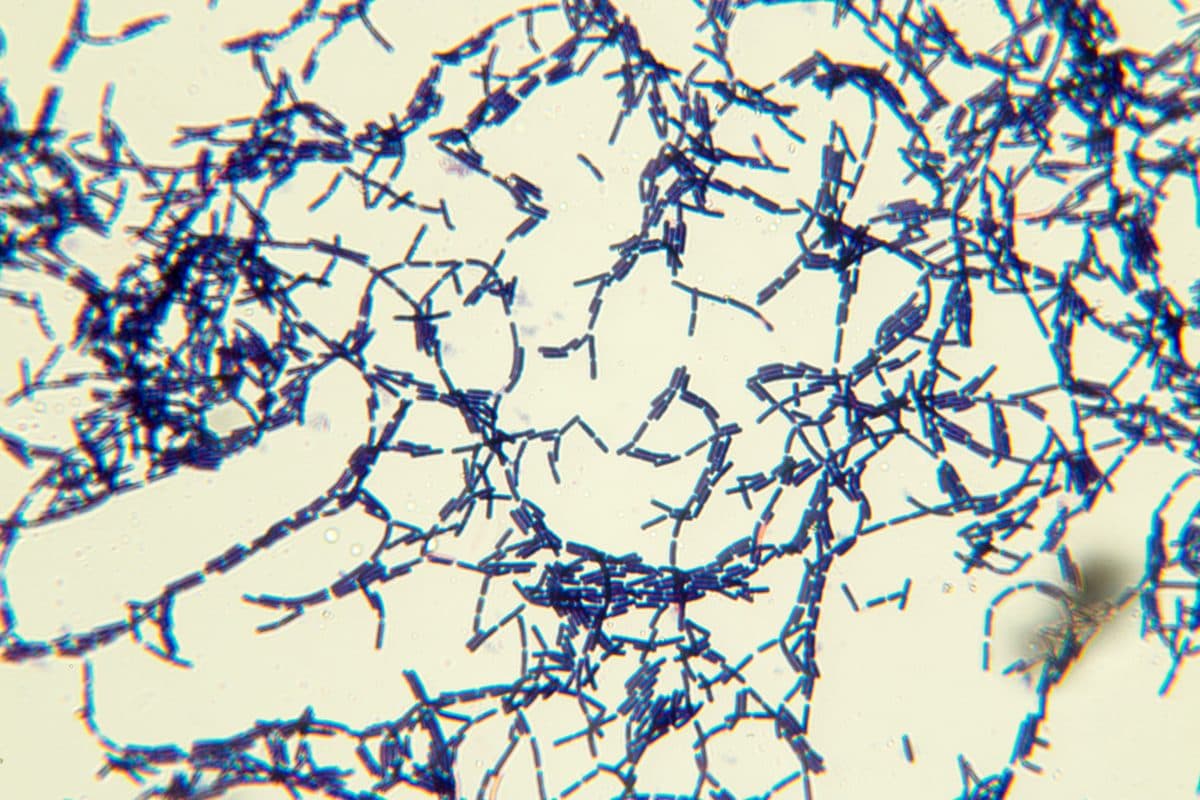
Bacillus is the workhorse of biological sludge reduction for two independent reasons. First, it is the pre-eminent industrial source of the enzymes the job needs: roughly half of the world's industrial enzyme supply is reported to come from Bacillus species, and selected strains secrete twenty to twenty-five grams of extracellular enzyme per litre. Second, it forms an endospore — a dormant, desiccation-resistant cell that survives drying, heat and long storage and revives on contact with water — which is what allows a viable product to be manufactured dry and shelf-stable. Nitrifying bacteria are the instructive opposite: they are Gram-negative Proteobacteria, they do not form spores, and a manufactured pure culture does not survive drying. That single microbiological fact is why a dry product line can reduce organic sludge but structurally cannot deliver the organisms that address an ammonia permit.
Why Bacillus produces the enzymes the job needs
The enzymes that hydrolyse sludge — proteases, amylases, lipases and cellulases — are, overwhelmingly, ones that Bacillus species are prized for producing at industrial scale. Reviews of the industrial enzyme sector report that around half of the total global enzyme market derives from Bacillus, with proteases alone accounting for a large share of all enzymes sold, and that alpha-amylase is chiefly a Bacillus product. Familiar workhorse species — Bacillus subtilis, licheniformis, amyloliquefaciens and their relatives — are named repeatedly as high-yield producers, and selected strains have been shown to secrete twenty to twenty-five grams of enzyme per litre, placing them among the most productive industrial organisms known.
~50%
Share of the global industrial enzyme market reported to derive from Bacillus species.
Peer-reviewed
20–25g/L
Extracellular enzyme secretion demonstrated by selected Bacillus strains.
Peer-reviewed
~25%
Share of the world enzyme market represented by amylases, chiefly a Bacillus product.
Peer-reviewed
For a treatment product, check whether the selected strains produce enzymes suited to the sludge and remain viable through storage and application.
The endospore, and why the product can be sold dry
Under stress, a Bacillus cell forms an endospore: a metabolically dormant cell built to survive. The sporulation literature describes it as resistant to extremes of temperature, desiccation and ionising radiation, with estimates of longevity running from thousands to millions of years, and capable of resuming growth — germinating — when environmental conditions signal that it is worth doing. Spore formation is a defining trait of the Gram-positive Firmicutes, the phylum Bacillus belongs to.
Bacillus spores tolerate drying, which allows them to be packaged and transported in dry products. They germinate when water, temperature and nutrients are suitable. Product storage conditions and viable-count guarantees still need checking.
The nitrifier contrast, and what it forecloses
The clearest way to see why the spore matters is to look at an organism that has none. Nitrifying bacteria — Nitrosomonas and Nitrobacter, which oxidise ammonia and nitrite and are therefore the organisms that matter for a nitrogen permit — are Gram-negative Proteobacteria, not Firmicutes. They cannot form endospores, because endospore formation is a Firmicutes trait, and the experimental record bears out the consequence: a laboratory culture of Nitrosomonas europaea could not be recovered after air-drying. A manufactured pure culture behaves the same way. It dies.
Choose a product by its specified function. Delivering sludge-digesting organisms to the bottom of a lagoon and supporting nitrification are different applications.
References
- İnan Bektaş, K., Nalcaoğlu, A., Ceylan, E. et al. (2023). Isolation and characterization of detergent-compatible amylase-, protease-, lipase-, and cellulase-producing bacteria. Brazilian Journal of Microbiology 54(2): 725–737. DOI: 10.1007/s42770-023-00944-0Peer-reviewedAbout half of the global industrial enzyme market derives from Bacillus species; proteases are a large share of all enzymes sold.
- Souza, P. M. de & Magalhães, P. de O. (2010). Application of microbial α-amylase in industry — a review. Brazilian Journal of Microbiology 41(4): 850–861. DOI: 10.1590/S1517-83822010000400004Peer-reviewedα-amylase is chiefly a Bacillus product; amylases are roughly a quarter of the world enzyme market.
- Schallmey, M., Singh, A. & Ward, O. P. (2004). Developments in the use of Bacillus species for industrial production. Canadian Journal of Microbiology 50(1): 1–17. DOI: 10.1139/w03-076Peer-reviewedSelected Bacillus strains secrete 20–25 g/L of extracellular enzymes, among the highest of any industrial producer.
- Higgins, D. & Dworkin, J. (2012). Recent progress in Bacillus subtilis sporulation. FEMS Microbiology Reviews 36(1): 131–148. DOI: 10.1111/j.1574-6976.2011.00310.xPeer-reviewedThe endospore is a dormant cell resistant to temperature, desiccation and radiation that germinates in response to environmental signals.
- Galperin, M. Y. (2013). Genome Diversity of Spore-Forming Firmicutes. Microbiology Spectrum 1(2): TBS-0015-2012. DOI: 10.1128/microbiolspectrum.TBS-0015-2012Peer-reviewedEndospore formation is confined to the Firmicutes — the reason Gram-negative nitrifiers cannot form spores.
- Allison, S. M. & Prosser, J. I. (1991). Survival of ammonia oxidising bacteria in air-dried soil. FEMS Microbiology Letters 79(1): 65–68. DOI: 10.1111/j.1574-6968.1991.tb04506.xPeer-reviewedA laboratory Nitrosomonas europaea culture could not be recovered after air-drying — a manufactured pure culture behaves the same way.
- Koops, H.-P. & Pommerening-Röser, A. (2001). Distribution and ecophysiology of the nitrifying bacteria emphasizing cultured species. FEMS Microbiology Ecology 37(1): 1–9. DOI: 10.1111/j.1574-6941.2001.tb00847.xPeer-reviewedEstablishes the nitrifiers as Gram-negative Proteobacteria, outside the spore-forming Firmicutes.
Common questions
- Why is Bacillus used in almost every sludge-reduction product?
- Because it is the dominant industrial source of the enzymes the job requires — roughly half of the world's industrial enzyme supply is reported to come from Bacillus species — and because it forms an endospore that survives drying and storage. That combination lets a manufacturer put the organisms that do the work into a dry, shelf-stable product without losing viability.
- How does a dry bacterial product stay alive on the shelf?
- The organisms are present as endospores, a dormant and highly resistant cell state that survives desiccation, heat and long storage and germinates when it reaches warm water and organic material. It is a natural survival strategy of Bacillus and its relatives, not an additive or a preservative.
- Why can a dry product not treat ammonia or nitrogen?
- Because the organisms that oxidise ammonia — nitrifiers such as Nitrosomonas and Nitrobacter — are Gram-negative Proteobacteria that do not form spores, and a manufactured pure culture does not survive drying. Viable nitrifiers can only be supplied in a liquid, so no dry product addresses a nitrogen permit. That is not solved by having a liquid line: ours is a Bacillus line, and a nitrifier product is a different product. We do not sell one.
Related reading
- MechanismHow bioaugmentation reduces sludge
- Treatment guideWhen to start and stop treating
- Evidence reviewDoes bioaugmentation actually work?
Products for this duty
Find out which product fits your lagoon.
Describe it and the planner selects a format — or tells you that biological treatment is the wrong answer for it. Nothing is captured.