
Cost calculator
What would it cost to dredge your lagoon?
Enter the lagoon dimensions and measured sludge depth to estimate volume, dry tons and dredging cost. You can adjust the total solids percentage and contractor rate; both have a large effect on the estimate.
Estimated result
- Accumulated sludge volume
- 22,222 yd³600,000 ft³ · 4,488,312 gal
- Estimated dry solids
- 1,146 dry tons
$343,699independently cited range$916,531
How much of this is treatable?
A sludge sample is needed to measure the volatile organic fraction. Dimensions alone cannot tell you how much is potentially treatable. A lagoon containing mostly grit and silt may have little material that biological treatment can reduce.
Why only the volatile fraction respondsShow the arithmetic
Volume = length × width × average depth. Wet weight = volume × 62.4 lb/ft³ × specific gravity 1.02. Dry solids = wet weight × total solids percentage. Dry tons = dry solids ÷ 2,000.
Specific gravity is held at 1.02, a standard assumption for municipal lagoon sludge. Every figure this tool returns is an estimate for planning and comparison. Obtain a real dredging quotation before committing to a budget.
01The cost breakdown
Where the $350 per dry ton figure comes from, and how much to trust it.
The figure is repeated consistently across this industry, which makes it feel more established than it is.
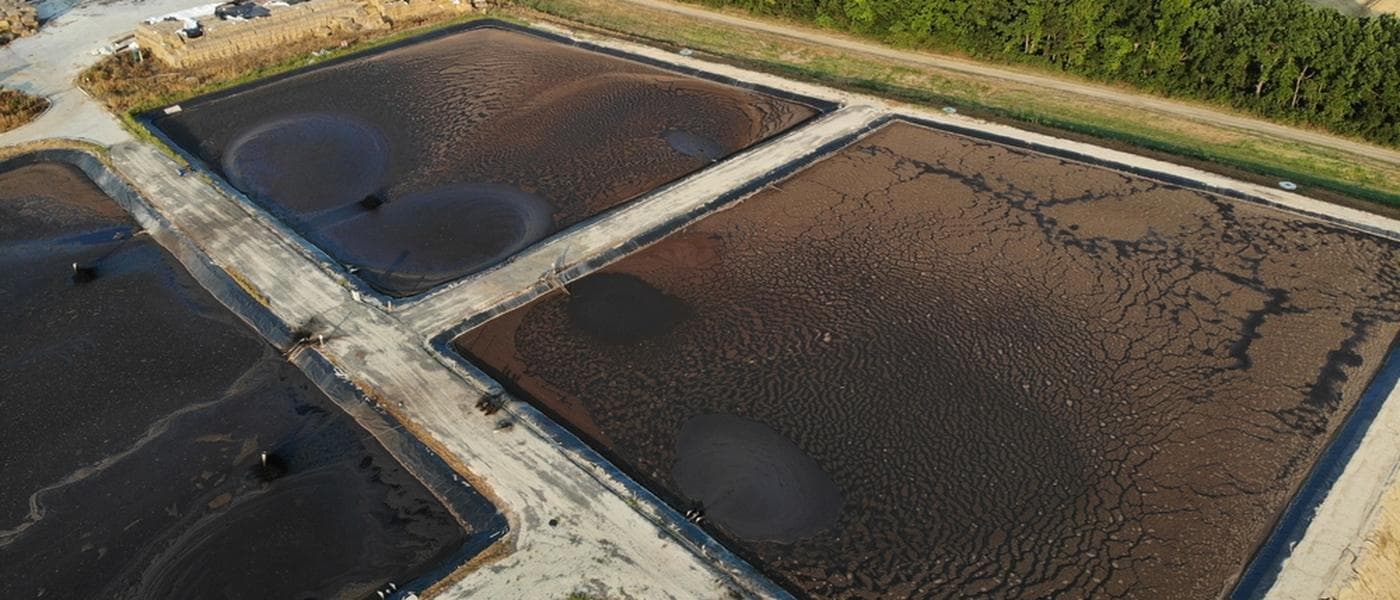
Almost every published source for the $350 per dry ton figure tracks back to a bioaugmentation or dredging vendor rather than to an independent engineering study. That does not make it wrong, but it does mean it should be treated as a category convention rather than as a benchmark. The broader independently cited range is nearer $300 to $800 per dry ton.
Against a lagoon holding 2,500 to 5,000 dry tons, that spread is the difference between roughly three quarters of a million dollars and something well over three million. Which is why the only figure worth budgeting against is a real quotation for your own lagoon.
What actually drives the number
- Total solids content. Volume converts to mass through this value, and it comes from laboratory analysis of a sample. Doubling the assumed solids percentage doubles the dry tonnage and therefore doubles the bill.
- Dewatering method. Geotextile tubes, a mechanical press and drying beds have very different cost profiles and very different footprints.
- Haulage and disposal. Distance to the disposal site and the route available — land application, landfill or further treatment — often matter more than the dredging itself.
- Access and downtime. Whether a cell can be taken offline, and what happens to flow while it is, can dominate everything else.
02The comparison that matters
Compare cost per dry ton removed, not price per pound of product.
A biological programme and a dredging contract are not the same purchase. Dredging is a capital event that restores full design volume and removes the inert fraction along with everything else. A programme is an annual operating cost that reduces the treatable portion and defers the capital event.
The useful question is therefore not which is cheaper but how many years of deferral the programme buys, and at what annual cost, against the quoted clean-out. That calculation needs three real numbers: a dredging quotation, a measured sludge volume in dry tons, and the volatile fraction that determines how much of it is treatable at all.
The financial benefit depends partly on how long treatment can defer dredging. Compare the annual treatment cost with the timing and cost of the expected clean-out.
Common questions
- How much does it cost to dredge a wastewater lagoon?
- Mechanical dredging is commonly quoted in the region of $350 per dry ton, though that figure is largely vendor-sourced and the broader independently cited range is nearer $300 to $800 per dry ton. Because a lagoon can hold 2,500 to 5,000 dry tons, a full clean-out commonly falls between $875,000 and $1.75 million. Actual cost depends on access, dewatering method, haulage distance and disposal route, so a real quotation is essential.
- How do you calculate dry tons of sludge in a lagoon?
- Multiply surface area by average measured sludge depth to get volume. Multiply volume by the density of water (62.4 lb per cubic foot) and the specific gravity of the sludge, typically about 1.02, to get wet weight. Multiply wet weight by the total solids percentage from laboratory analysis of a sample, then divide by 2,000 to convert pounds to tons.
- Why does the dredging cost estimate vary so widely?
- Two variables dominate and neither can be derived from lagoon dimensions. Total solids content determines how much dry mass a given volume of sludge represents, and it is only known from laboratory analysis of a sample. The contractor rate varies with access, dewatering method, haulage and disposal. An estimate built on assumed values for both should be treated as an order-of-magnitude figure only.