
Dense sinking solid
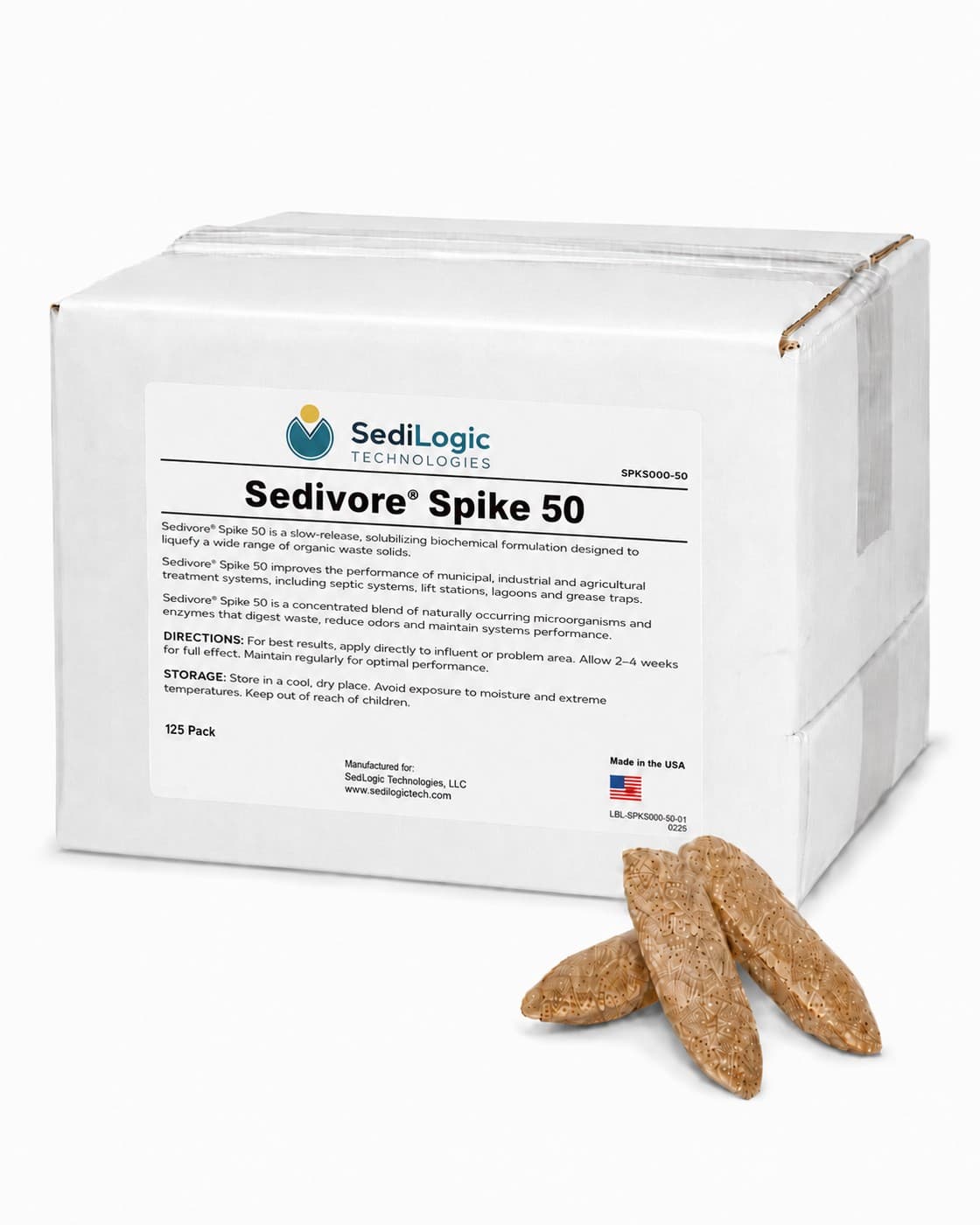
Sedivore Spike
A dense sinking solid for organic sludge at the bottom of a lagoon. It falls through the water column and releases bacteria at or within the sludge surface.
$729
41.34 lb
Case of approximately 125 sinking solids; each solid approximately 150 g (5 oz), 13.5 cm long by 4 cm across (5.3 × 1.6 in)
41.34 lb
Added.View cart
Freight is added at checkout, and an order on a pallet is quoted before it ships. A person reads every order against the lagoon it is going to, and says so if the quantity looks wrong for the system.
01Why this format
Accumulated organic bottom sludge
Spike is designed for deeper cells, where the bacteria need to reach a settled sludge blanket. Its weight and shape carry the blend down through the water.
It works at the sludge interface, and it suits an established blanket under depth.
02Specifications
Product specifications and documents
The specifications below come from product documents. If a document does not provide a value, we mark it as unpublished.
- Pack size
- Case of approximately 125 sinking solids; each solid approximately 150 g (5 oz), 13.5 cm long by 4 cm across (5.3 × 1.6 in)
- Pack weight
- 41.34 lbNet contents — 18.75 kg, which is exactly 125 solids at 150 g each.
- Shipping weight
- 41.56 lbGross weight as shipped, including packaging.
- Pack price
- $729Indicative. Freight, tax and the final price are settled in the reviewed quote.
- Dose rate
- Sized on treated surface area from the manufacturer's own application sheet: 8 to 12 cases per acre for the initial dose, with municipal wastewater and simpler organic loads dosed at the low end of that range. The dosing planner returns the quantity and an indicative cost for your system.An area-based rate, so it needs your acreage rather than a depth. The planner sizes the low end of the published range; where a load is heavier than municipal, the review moves it up.
- Storage
- Store in a cool, dry place at 50–95°F (10–35°C) and 30–60% relative humidity; keep the container closed and avoid inhaling dust.A humidity limit as well as a temperature one. A dry compacted solid held damp loses condition before its date.
03When not to buy this
When to consider another approach
- Most of the accumulation is grit, sand, silt or mineral precipitate. Biological treatment cannot remove those materials.
- Mixing or aeration needs attention first. Biological treatment cannot compensate for those problems.
- You need capacity restored by a fixed date. Biological treatment is gradual and seasonal; compare physical removal options for an urgent deadline.
The planner checks these conditions before calculating a quantity.
04Microbiology
How bacteria break down organic sludge
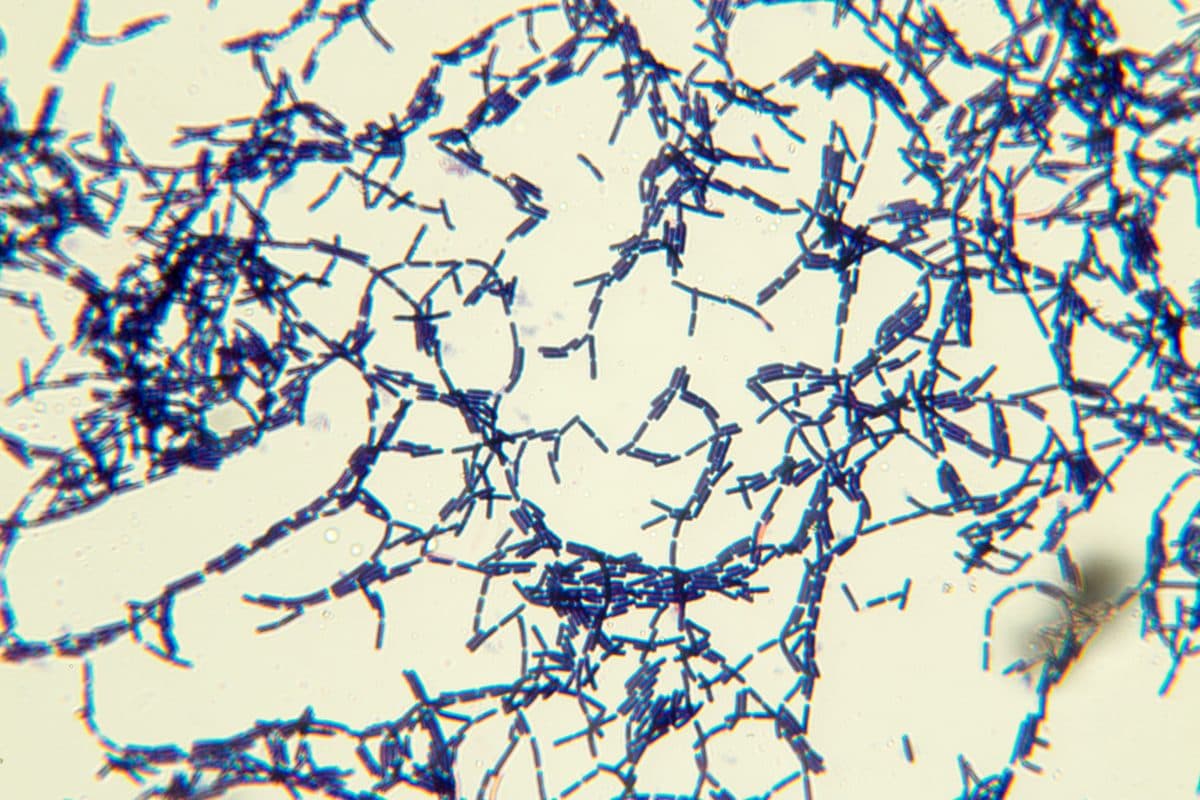
The mechanism is enzymatic hydrolysis. Bacillus species release enzymes that break large organic molecules into smaller, soluble fragments. Bacteria then take up and metabolise those fragments.
| Enzyme | Acts on | What that is, in a lagoon |
|---|---|---|
| Protease | Proteins and peptides | The protein fraction of settled influent solids and of dead biomass. |
| Lipase | Fats, oils and greases | FOG, which floats and consolidates rather than settling out on its own. |
| Amylase | Starches and complex carbohydrates | Carbohydrate load, typically heaviest on food-processing influent. |
| Cellulase | Cellulose | Plant fibre and paper, which is a large share of a municipal blanket. |
Why Bacillus works in dry treatments
Bacillus produces these enzymes and forms spores that tolerate drying and storage. The spores germinate when conditions are suitable. This makes Bacillus useful in dry sludge treatments. These products are not intended to address an ammonia permit; that requires a separate assessment of nitrification.
What the published work supports
Mixtures of protease, cellulase and lipase reduce total suspended solids by 30 to 50 per cent and improve settling, with protease and cellulase together outperforming either alone. One controlled study reported 33 per cent volatile suspended solids reduction.
These studies explain the mechanism; they do not predict results from a SediLogic product. The research is collected in the scientific literature.
05Microbiological specification
Product specifications
These figures come from the product documents. Values that the documents do not provide are marked as unpublished.
- Viable count at manufacture
- 5–6 billion CFU/gPer gram, at manufacture. Each sinking solid is approximately 150 g.
- Guaranteed count at end of shelf life
- 75% of the count at manufactureThe guaranteed count at the end of the 24-month shelf life is 3.75 to 4.5 billion CFU/g, based on the range above.
- Strains in the blend
- 6–8 Bacillus strainsSpecified as a range rather than a fixed count. The strains themselves are not published.
- Operating temperature range
- 68–104°FThe operating range for the organisms, converted from the manufacturer's 20–40°C. Not the storage range, which is lower.
- Operating pH range
- 6.0–9.0
- Biosafety level
- Not publishedThe product documentation describes the bacteria as non-pathogenic but publishes no Biosafety Level designation.
- Shelf life
- 24 monthsKeep in the unopened original packaging, cool, dry and out of direct sunlight. The viable-count guarantee covers the stated shelf life under these storage conditions.
The range
Other formats, and what each one is for
Choose the format according to where the material has accumulated and how you apply treatment. Sinking solids target settled bottom sludge. Soluble pouches and liquids disperse in the water column.
Same duty — Sludge interface
Elsewhere in the range
- SediLogic MaintainDry water-soluble pouchMaintenance dosing and general organic load
- Sedivore PolarDry water-soluble pouch, cold-weather blendOrganic load in a lagoon running cold
- SediLogic Maintain ConcentrateHigh-concentrate soluble pouchGeneral organic load on large systems
- SediLogic Maintain PlusDry water-soluble pouch, high concentrationMaintenance dosing and general organic load
- Sedivore Polar PlusDry water-soluble pouch, high concentration, cold-weatherOrganic load in a lagoon running cold
- SediLogic LiquidLiquid concentrateOrganic load in systems a solid cannot be dosed into
- SediLogic Liquid ColdLiquid concentrate, cold-weather blendOrganic load in liquid-dosed systems running cold
- SediLogic Liquid FOGLiquid concentrate, FOG-targetedFats, oils and grease, and the collection systems where they gather