
Wastewater lagoon sludge
What lagoon sludge is, why it accumulates, what it costs you in lost capacity and permit risk, and the options available for dealing with it.
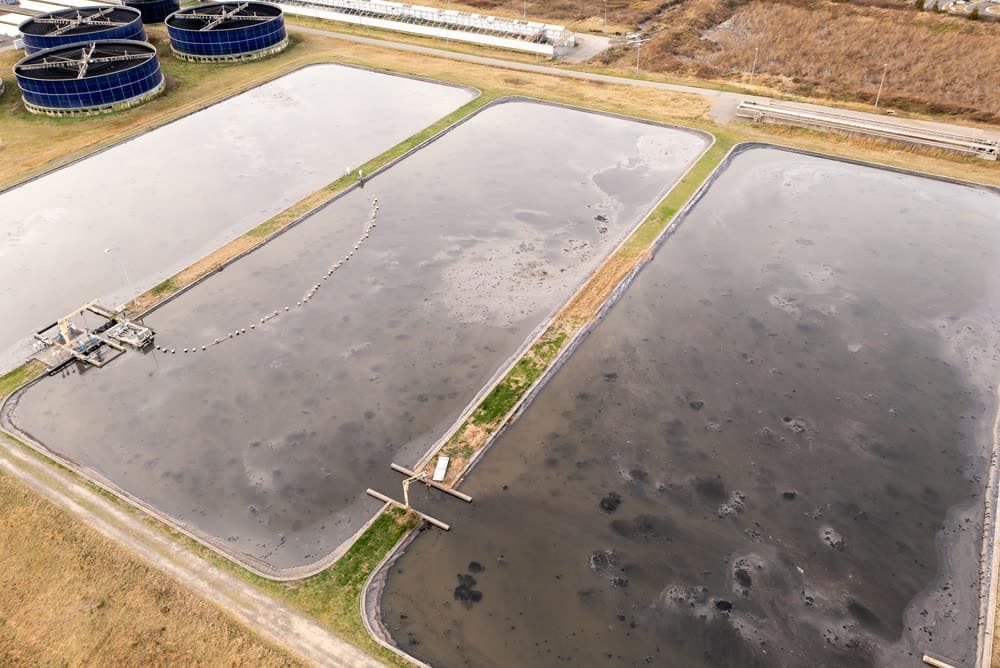
The short answer
Wastewater lagoon sludge is the layer of settled solids that accumulates on the floor of a treatment lagoon. It has two components that behave completely differently: a volatile organic fraction that is biodegradable and can be digested biologically, and an inert fraction of sand, grit, silt, mineral precipitates and plastics that is not biodegradable and will remain regardless of treatment. As the blanket builds it reduces detention time and effective volume, erodes freeboard, and eventually puts effluent quality and permit compliance at risk. Managing it means first measuring how much there is and what proportion is treatable, then choosing between biological reduction, mechanical dredging, or a combination of the two.
Why lagoons accumulate sludge
A treatment lagoon works by giving solids time to settle and biology time to act. Both of those things produce sludge. Influent solids settle out, biomass grows and dies, and the fraction of that material which is not digested under the anaerobic conditions at the lagoon floor simply stays there. Accumulation is not a fault condition. It is the system doing what it was designed to do, and it is why every lagoon has a finite service interval before it needs attention.
Roughly 4,657 lagoon facilities hold NPDES permits in the United States, representing about a quarter of all municipal wastewater treatment facilities, with something closer to 8,000 once non-discharging systems are included. Sludge handling represents 40 to 60 percent of total operating cost at many treatment facilities.
The two fractions, and why the distinction decides everything
The single most useful thing to understand about lagoon sludge is that it is not one material. The volatile organic fraction is biodegradable: it is the protein, fat, carbohydrate and cellulose that microbial enzymes can hydrolyse. The inert fraction is not. Sand, grit, silt, mineral precipitates and plastics will remain in the lagoon regardless of dose, product or format.
This is why any credible assessment starts with a sample rather than a sales call. Two lagoons of identical dimensions holding identical depths of sludge can have completely different treatable fractions, and therefore completely different sensible answers to the question of what to do next.
What sludge accumulation actually costs
| Consequence | How it shows up |
|---|---|
| Lost treatment capacity | Reduced effective volume and shorter detention time, so the biology has less time to act on incoming load. |
| Eroded freeboard | Less margin between water surface and the top of the berm, which matters during storm events. |
| Permit risk | Rising BOD and TSS in the effluent as detention time falls. Clean Water Act penalties are adjusted annually and run to tens of thousands of dollars per day per violation. |
| Short-circuiting | Uneven accumulation channels flow across the cell rather than through it, which reduces effective treatment further than the volume loss alone would suggest. |
| A very large future bill | Mechanical clean-out is the largest single line item most small utilities will face on a lagoon. |
The options
There are three broad routes, and the honest position is that they are complementary rather than competing. Mechanical dredging removes everything, including the inert fraction, and is the only option that fully restores design volume. Biological reduction digests the volatile fraction and defers the mechanical event. Improving mixing and aeration addresses the conditions that limit both biological treatment and overall lagoon performance.
Where to start
Measure. You cannot size a dredging contract, evaluate a treatment proposal, or defend a capital request to a council without knowing how much material is in the lagoon and where it sits. A survey that produces sludge depth by location, total volume in dry tons, the volatile fraction and an estimated dredging cost gives you the basis for every subsequent decision — including the decision to do nothing for another two years.
Sources
- Nelson, K. L., Jiménez Cisneros, B., Tchobanoglous, G. & Darby, J. L. (2004). Sludge accumulation, characteristics, and pathogen inactivation in four primary waste stabilization ponds in central Mexico. Water Research 38(1): 111–127. DOI: 10.1016/j.watres.2003.09.013Peer-reviewedOne of the few field studies to characterise a pond's benthic layer directly rather than infer it. The closest thing to an independent measurement of how, and how fast, a lagoon fills.
- US EPA. Lagoon Wastewater Treatment Systems. US Environmental Protection Agency.RegulatorThe Agency's own overview of how lagoon systems are meant to work, and the operating problems it expects them to develop.
- US EPA (2022). The Universe of Lagoons: An Analysis of State and Tribal Lagoon Wastewater Systems. US Environmental Protection Agency.RegulatorThe source for how many lagoon facilities there are and what condition they are in. Where the facility counts quoted on this site come from.
Common questions
- How often should lagoon sludge be measured?
- Many discharge permits require a sludge survey on a defined cycle, commonly every five years, and operators frequently measure more often than that once accumulation becomes material. Measuring on a consistent cycle with a consistent method is what makes surveys comparable over time and turns them into a trend rather than a snapshot.
- How deep does lagoon sludge get before it becomes a problem?
- There is no single threshold, because it depends on the design depth of the cell, the freeboard available, and how uneven the accumulation is. What matters is the proportion of design volume lost and whether the distribution is causing short-circuiting, which is why a contour map is more useful than a single depth reading.
Related reading
- MethodologyHow to measure sludge in a lagoon
- Technical explainerVolatile solids vs total solids
- Pillar guideLagoon sludge removal methods
Products for this duty
Find out which product fits your lagoon.
Describe it and the planner selects a format — or tells you that biological treatment is the wrong answer for it. Nothing is captured.