
Skip to content
SediLogic Technologies

Wastewater lagoons

Swine manure lagoon

Suspended solids and phosphorus in a manure lagoon at concentrations that constrained where the contents could go.

91%

reduction in total suspended solids

Field resultThird-party lab
Duty
Wastewater lagoons
Sector
Agricultural
Treatment window
6 weeks
What was counted
Suspended solids, BOD and COD
  • Phosphorus down 85 per cent
  • COD down 84 per cent
  • Figures attributed to an accredited outside laboratory
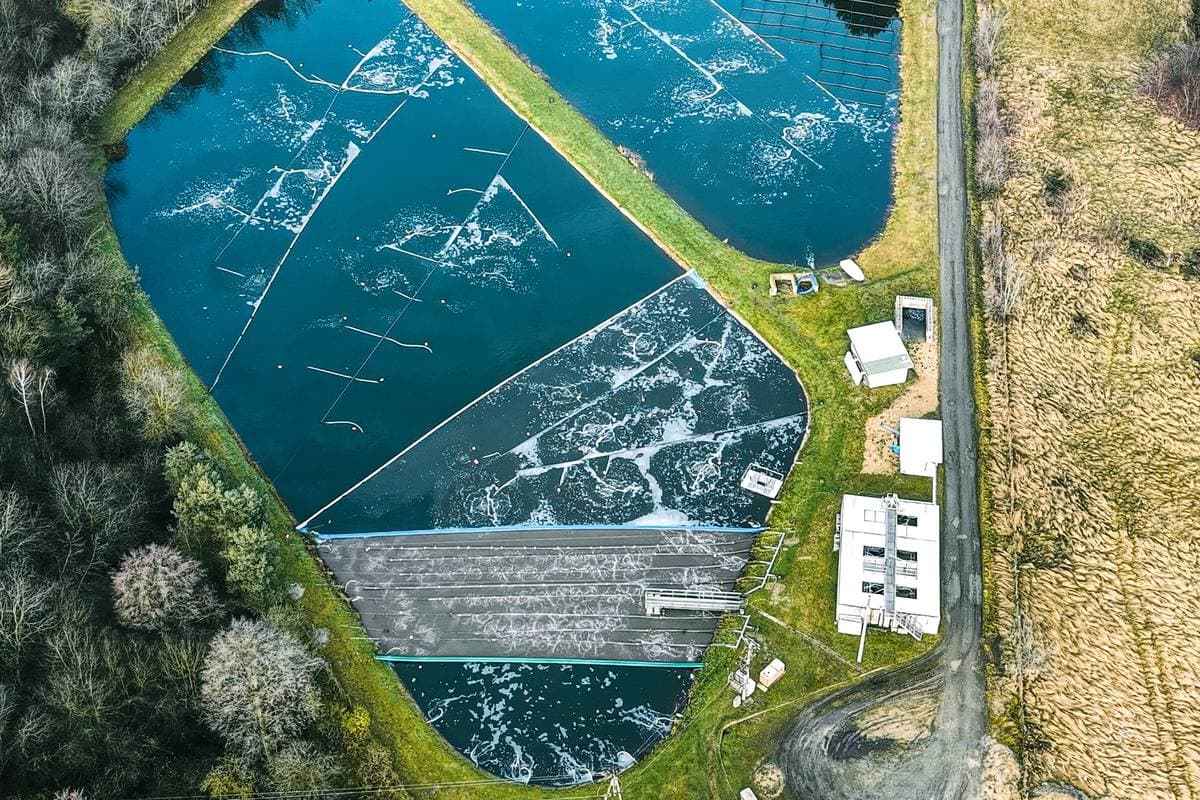
Aerial view of a multi-cell aerated wastewater lagoon, its surface broken by aeration, with grass berms dividing the cells and a small control building alongside.
Illustration — an operating aerated lagoon, not the works described on this page.

01The plant

What was being treated

An anaerobic manure lagoon holding the raw slurry of a commercial swine operation.

02Before

How the material got there

The lagoon was measured on one thing: how far a full effluent panel could be pulled down. Suspended solids ran 37,500 mg/L, chemical oxygen demand 66,600 and biochemical oxygen demand 11,850. Settleable solids were pegged at 1,000 mL/L — the top of the scale on a standard Imhoff cone, meaning the slurry never separated at all. Phosphorus, which usually decides what an operation may do with its effluent, sat at 363.25 mg/L. Dissolved oxygen of 0.2 mg/L and pH 8.0 confirmed what kind of lagoon it was.

03Treatment

What was applied, and how

A drop-in tablet form that sinks and dissolves on its own, so there was no mixing, no dosing equipment and no added labour. The constraint the site set was that nothing else could change — no aeration, no dredging, no new equipment and no interruption to normal loading — so the lagoon ran exactly as it always had.

Every result in this library was measured at an operating plant treating with one of the formulations SediLogic supplies, over the window stated above. It is a field result published as reported, not a controlled trial we ran.

04Method

How the result was established

A baseline sample drawn before anything went in, and a second at forty-one days. Both were analysed by an environmental laboratory accredited by the American Association for Laboratory Accreditation, following Standard Methods for the Examination of Water and Wastewater, 23rd edition. The sampling itself was done by the operation rather than by the laboratory.

05Outcome

What followed

The settleable-solids reading explains the rest of the panel. At the start the cone held a single flocculent mass with no clear liquid above it after the standard settling hour; at forty-one days the same test gave a distinct sludge layer with clear liquid over it. The lagoon's own level dropped as the blanket shrank, so storage came back without the lagoon being drained.

At the start

Suspended solids 37,500 mg/L, COD 66,600, BOD 11,850, phosphorus 363.25, total nitrogen 4,100, settleable solids 1,000 mL/L.

At the close

Suspended solids 3,400 mg/L, COD 10,720, BOD 5,699, phosphorus 54, total nitrogen 3,012.5, settleable solids 3 mL/L.

06Limits

What this record does not establish.

Day zero is a baseline, not an untreated control, and the publisher says so plainly — this is a before-and-after at one lagoon rather than treated against untreated. The sampling was done by the operation and the analysis by the accredited laboratory, which is exactly where a sampling difference would enter and not be visible in the result. The reduction goals quoted are the operation's own internal targets and not a regulatory limit. Six weeks of an anaerobic lagoon is six weeks of weather and loading that nobody recorded.

Only the volatile organic fraction of a sludge responds to any of this. Grit, sand, silt, mineral precipitates and plastics remain at any dose, here and everywhere else.

What we would supply

For this duty, in our range.

This is the duty SediLogic supplies and sizes. Which article depends on where the material sits: Sedivore Spike is the denser solid and carries down through depth to an established blanket, Sedivore Puck is a smaller unit that spreads a calculated dose across the bed, and SediLogic Maintain is a soluble pouch for load carried in the water column — with Sedivore Polar for that same duty where the water runs cold enough to stall a standard blend.

A quantity for your own lagoon comes from the dosing planner, sized against your dimensions and loading from the manufacturer's written dose method. It does not come from the figure on this page, which was set for a lagoon that is not yours.

Read next

The same duty, measured somewhere else.

  • Wastewater lagoons

    Resort wastewater lagoon, Hawaii

    Municipal30 days

    Single digits

    effluent suspended solids, from a starting figure that was never recorded

    Field resultNo method statedConfounded

    A forty-year-old lagoon carrying heavy accumulated solids and an effluent suspended-solids figure the resort could not hold.

    • Dosed at 1 ppm of influent flow
    • A fine-bubble aeration system was installed during the same window
    Suspended solids
  • Wastewater lagoons

    Agricultural lagoon serving 8,000 dairy cows, South America

    Agricultural4 months

    83%

    reduction in total suspended solids

    Field result

    A lagoon loaded well past what it was built for, carrying a foam layer across most of the surface and blocking the irrigation draw.

    • TSS 18,650 mg/L to 3,220 mg/L
    • BOD₅ 5,195 mg/L to 2,752 mg/L, a 47 per cent reduction
    • COD rose over the same period, from 18,211 mg/L to 19,303 mg/L
    • Around 70 per cent of the water surface reported clear of foam
    Suspended solidsBOD and COD
  • Wastewater lagoons

    Barbourville, Kentucky

    Municipal24 weeks

    43.3%

    of accumulated solids digested

    Field result

    Just over five feet of accumulated solids in the primary aerated lagoon, assessed at 2,365 dry tons. The plant wanted a route that did not involve dredging.

    • 1,025 dry tons removed
    • Average depth 5.08 ft to 2.65 ft
    Sludge depth and solids

All field results

Your lagoon next

This was measured somewhere else.

A different plant, a different loading and a different sludge. What decides your result is how much of your own accumulation is organic and treatable, and whether the dose is sized against the lagoon in front of us rather than read off this page. Tell us the dimensions and we will size it.