
Skip to content
SediLogic Technologies

Wastewater lagoons

Pulp mill aerated lagoon, Canada

Decades of accumulation had left half a metre of freeboard on a four-metre basin, with three and a half metres of it solids, and the retention time gone with it.

0.75m

average reduction in sludge depth

Field result
Duty
Wastewater lagoons
Sector
Industrial
Treatment window
April to October
What was counted
Sludge depth and solids, Capacity and retention time
  • Up to 1.5 m in places
  • Basin capacity 26,154 m³ in April to 28,125 m³ in October
  • Around 2,000 m³ (54,000 ft³) of capacity recovered
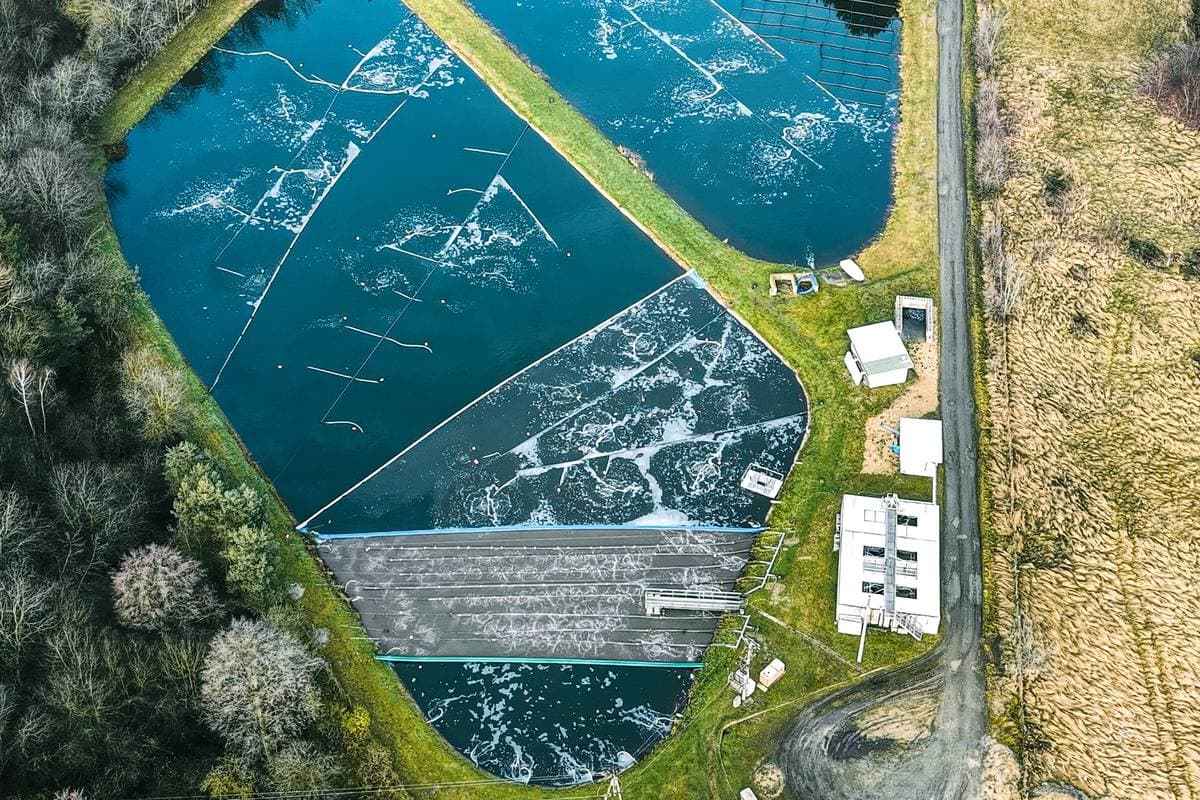
Aerial view of a multi-cell aerated wastewater lagoon, its surface broken by aeration, with grass berms dividing the cells and a small control building alongside.
Illustration — an operating aerated lagoon, not the works described on this page.

01The plant

What was being treated

An aerated wastewater lagoon at a Canadian pulp mill, 4 m (13 ft) deep, with as little as 0.5 m (1.6 ft) of freeboard at one end over 3.5 m (11.4 ft) of accumulation.

02Before

How the material got there

Decades of solids accumulation had cut capacity and retention time and had begun to show in effluent quality. The alternative was dredging the whole lagoon.

03Treatment

What was applied, and how

Fifty cases of a dense sinking solid applied over a 5-acre zone, periodically between April and July.

Every result in this library was measured at an operating plant treating with one of the formulations SediLogic supplies, over the window stated above. It is a field result published as reported, not a controlled trial we ran.

04Sizing

What the quantity was set against

Sized against the treated area rather than lagoon volume — a surface-area basis, which is how a sinking solid is placed over a blanket.

05Method

How the result was established

A local engineering firm ran a bathymetric survey of the lagoon before treatment and returned to re-measure after it. An outside survey at both ends is the strongest method in this library.

06Outcome

What followed

Effluent quality was reported as improved, and dredging the whole lagoon was pushed further out.

At the start

3.5 m (11.4 ft) of accumulation at the worst end, freeboard down to 0.5 m (1.6 ft).

At the close

0.75 m (2.4 ft) less accumulation on average across the treated area, up to 1.5 m (4.9 ft) in places, and 2,000 m³ (54,000 ft³) of water volume recovered.

07Limits

What this record does not establish.

The average and the maximum are given but not the spread between them, and a 1.5 m best case alongside a 0.75 m average is a wide scatter within one lagoon. No untreated area was surveyed. The volatile fraction of the accumulation is not stated, which for a pulp mill matters more than usual — fibre is not equally degradable.

Only the volatile organic fraction of a sludge responds to any of this. Grit, sand, silt, mineral precipitates and plastics remain at any dose, here and everywhere else.

What we would supply

For this duty, in our range.

This is the duty SediLogic supplies and sizes. Which article depends on where the material sits: Sedivore Spike is the denser solid and carries down through depth to an established blanket, Sedivore Puck is a smaller unit that spreads a calculated dose across the bed, and SediLogic Maintain is a soluble pouch for load carried in the water column — with Sedivore Polar for that same duty where the water runs cold enough to stall a standard blend.

A quantity for your own lagoon comes from the dosing planner, sized against your dimensions and loading from the manufacturer's written dose method. It does not come from the figure on this page, which was set for a lagoon that is not yours.

Read next

The same duty, measured somewhere else.

  • Wastewater lagoons

    Barbourville, Kentucky

    Municipal24 weeks

    43.3%

    of accumulated solids digested

    Field result

    Just over five feet of accumulated solids in the primary aerated lagoon, assessed at 2,365 dry tons. The plant wanted a route that did not involve dredging.

    • 1,025 dry tons removed
    • Average depth 5.08 ft to 2.65 ft
    Sludge depth and solids
  • Wastewater lagoons

    Inkom, Idaho

    MunicipalFive months, May to October

    48%

    reduction in solids volume overall

    Field result

    Accumulated solids across two lagoon cells, against a specification calling for a 50 per cent reduction. The treatment window was bounded by water temperature, which has to stay above roughly 55°F for the organisms to work at all.

    • Cell 1: 75.2 per cent
    • Cell 2: 37.5 per cent
    Sludge depth and solids
  • Wastewater lagoons

    Municipal WWTP, United States

    Municipal3 months

    672,659lb

    of organic solids digested

    Field result

    Decades of loading had taken the lagoon to a measured 20.5 per cent solids, with a dredging quotation in hand and no budget line to meet it.

    • Dredging deferred, not ruled out
    • A 4.5x cost saving against the dredging quotation
    Sludge depth and solids

All field results

Your lagoon next

This was measured somewhere else.

A different plant, a different loading and a different sludge. What decides your result is how much of your own accumulation is organic and treatable, and whether the dose is sized against the lagoon in front of us rather than read off this page. Tell us the dimensions and we will size it.