
Sachet soluble haute concentration
SediLogic Maintain Concentrate
SediLogic Maintain, concentré. Le même sachet hydrosoluble ciblant la colonne d'eau, formulé à environ dix fois la concentration standard — ainsi le programme d'une grande lagune arrive dans une fraction des seaux à expédier, stocker et manipuler.
01Pourquoi ce format
Charge organique générale sur grands systèmes
Sur un grand système, un programme à concentration standard représente beaucoup de seaux, et la majeure partie de ce poids est du support plutôt que des organismes. Un concentré livre les mêmes organismes dans bien moins de matière. C'est une économie de fret et de manutention, pas un produit plus fort : la lagune ne répond toujours qu'à sa fraction volatile, et ce plafond ne bouge pas avec la concentration. Il fait le travail sur la colonne d'eau — pour un tapis benthique établi, le solide dense qui coule reste l'outil, à toute concentration. Comme il justifie sa place par le volume, une commande de concentré est confirmée avec une personne plutôt que dimensionnée dans le planificateur.
Ça marche dans le colonne d'eau, et ça convient une grande lagune où le nombre de sachets standard devient ingérable.
02Spécifications
Spécifications et documents du produit
Chaque valeur ci-dessous provient d'un document produit. Lorsque les documents ne publient aucune valeur, la ligne le dit plutôt que de porter une estimation : un chiffre qui bouge ensuite est pire qu'un blanc assumé, car un exploitant a pu dimensionner une commande autour.
- Conditionnement
- Seau de 25 lb (11,3 kg) contenant 25 sachets hydrosolubles de 1 lb (454 g)
- Poids du paquet
- 25 lb
- Poids expédié
- 27.21 lbPoids brut d'expédition calculé, y compris une marge de 1 kg pour l'emballage.
- Prix du pack
- $4 712Indicatif. Le transport, les taxes et le prix final sont arrêtés dans le devis révisé.
- Débit de dose
- Dimensionné lors de la revue à partir de la méthode de dosage du fabricant (rév. 2026-07-16), à un dixième de la masse de Maintain standard. Le planificateur identifie quand un programme pour un grand système justifie le concentré, puis une personne confirme la quantité en seaux entiers.La concentration modifie la masse à expédier et à manipuler, non la dose d'organismes viables apportée à la lagune.
- Stockage
- Conserver dans un endroit sec et frais, à l'abri de la lumière directe du soleil ; maintenir le récipient hermétiquement fermé.Une plage de stockage à température contrôlée de 50 à 90 °F est indiquée sur la documentation produit.
03Quand ne pas acheter ça
Quand envisager une autre solution
- Le système est assez petit pour que les sachets Maintain standard représentent déjà un nombre de seaux gérable. Le concentré justifie sa place par le volume ; en dessous, c'est simplement une unité plus grosse à acheter.
- Il y a un tapis de boue établi à réduire. Un sachet soluble se disperse dans la colonne d'eau, et atteindre un tapis à plusieurs pieds de profondeur est le travail du solide dense qui coule — la concentration n'y change rien.
- C'est un permis ammoniac ou azote qui est le vrai problème. Les bactéries nitrifiantes ne survivent pas au séchage, donc aucun produit sec, concentré ou non, ne peut traiter la nitrification.
Le planificateur de dosage examine chacun de ces cas et vous le dira plutôt que de vous diriger vers un devis.
04Microbiologie
Ce que les organismes font réellement au matériau.
Le mécanisme est l'hydrolyse enzymatique. Bacillus Les espèces sécrètent dans leur environnement des enzymes qui brisent les grosses molécules organiques en fragments suffisamment petits pour être absorbés et métabolisés. Les organismes ne consomment pas directement les boues ; ils publient les outils qui le démontent.
| Enzyme | Agit sur | Qu'est-ce que c'est, dans un lagune |
|---|---|---|
| Protéase | Protéines et peptides | La fraction protéique des solides décantés de l'affluent et de la biomasse morte. |
| Lipase | Graisses, huiles et graisses | FOG, qui flotte et se consolide plutôt que de se déposer tout seul. |
| Amylase | Amidons et glucides complexes | Charge en glucides, généralement la plus lourde sur les influents de la transformation alimentaire. |
| Cellulase | Cellulose | Les fibres végétales et le papier, qui constituent une part importante de la couche de boues municipale. |
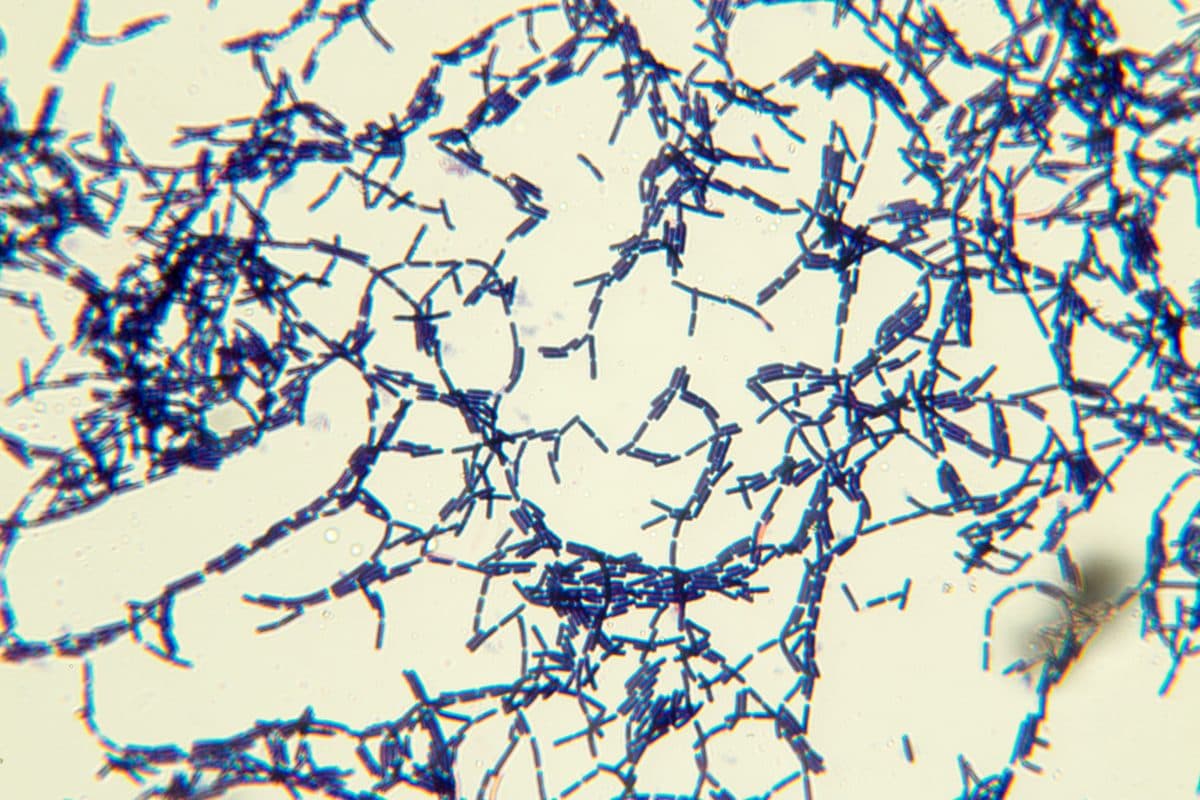
Pourquoi Bacillus convient aux traitements secs
Bacillus est la source bactérienne la plus importante de ces enzymes, en particulier des protéases. Il forme également des endospores – un état dormant qui survit au séchage, à la chaleur et au temps essentiellement intact, puis germe au contact de l’eau et de la nourriture. Pour ce travail, les organismes qui font le travail sont justement ceux qui sèchent le mieux, c'est pourquoi les deux formats de plomb sont secs et pourquoi cela ne coûte rien biologiquement. Les organismes nitrifiants sont le cas inverse : ils ne survivent pas du tout au séchage, c'est pourquoi aucun produit sec ne peut satisfaire à une autorisation pour l'ammoniac.
Ce que soutiennent les travaux publiés
Les mélanges de protéase, de cellulase et de lipase réduisent le total des matières en suspension de 30 à 50 pour cent et améliorent la décantation, la protéase et la cellulase étant ensemble surpassant chacune d'elles seules. Une étude contrôlée a rapporté une réduction de 33 pour cent des matières volatiles en suspension.
Ces chiffres constituent le mécanisme et non une affirmation concernant ce produit : les travaux enzymatiques et d'hydrolyse évalués par des pairs sur lesquels ils reposent sont collectés dans le littérature scientifique.
05Spécification microbiologique
Les chiffres et ce par rapport à quoi chacun est mesuré.
Les valeurs publiées dans les documents produit figurent ici. Lorsque les documents ne publient aucune valeur chiffrée, la ligne le dit plutôt que de porter une estimation.
- Nombre viable à la fabrication
- 40 milliards de CFU/gUn dénombrement publié sur la fiche produit ; aucune garantie de fin de durée de conservation n'est indiquée.
- Comptage garanti à la fin de la durée de conservation
- Non publiéAucun dénombrement de cellules viables garanti en fin de durée de conservation n'est publié pour ce produit.
- Variétés dans le mélange
- 7 souches de Bacillus
- Plage de température de fonctionnement
- Appliquer à 50°F ou plusUn seuil d'application repris de l'étiquette du produit, et non une plage de tolérance complète.
- Plage de pH de fonctionnement
- Non publiéAucune plage de pH de fonctionnement chiffrée n'est publiée pour ce produit.
- Niveau de biosécurité
- Non publiéLa documentation produit décrit les bactéries comme non pathogènes mais ne publie aucune classification de niveau de biosécurité.
- Durée de conservation
- 24 months
La gamme
Autres formats, et l'usage de chacun
Choisissez le format selon l’emplacement des dépôts et le mode d’application. Les solides lestés ciblent les boues du fond. Les sachets solubles et les liquides se dispersent dans la colonne d’eau.
Même usage — Colonne d'eau
- SediLogic MaintainPochette sèche hydrosolubleDosage d'entretien et charge organique générale
- Sedivore PolarSachet sec hydrosoluble, mélange grand froidLa charge organique d'une lagune qui tourne en eau froide
- SediLogic Maintain PlusSachet sec hydrosoluble, haute concentrationDosage d'entretien et charge organique générale
- Sedivore Polar PlusSachet sec hydrosoluble, haute concentration, eau froideLa charge organique d'une lagune qui tourne en eau froide
Ailleurs dans la gamme
- Sedivore SpikeSolide dense et coulantBoues de fond organiques accumulées
- Sedivore PuckSolide plongeant dispersibleBoues de fond organiques accumulées
- SediLogic LiquidConcentré liquideCharge organique dans les systèmes où un solide ne peut pas être dosé
- SediLogic Liquid ColdConcentré liquide, mélange pour temps froidCharge organique dans les systèmes dosés au liquide fonctionnant à basse température
- SediLogic Liquid FOGConcentré liquide, ciblé FOGGraisses, huiles et graisses, et les systèmes de collecte où elles sont collectées